
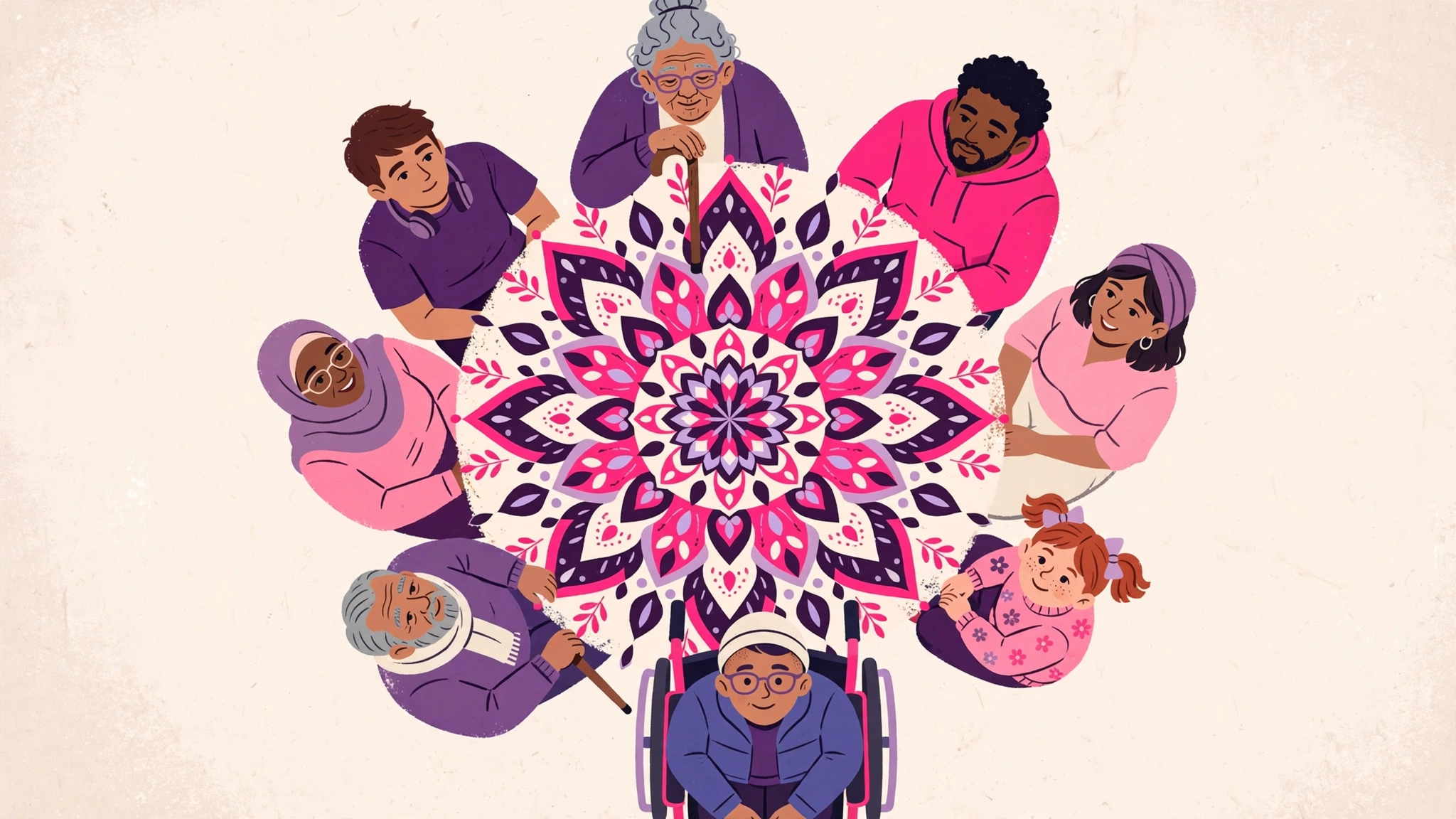
Living with pain every day changes how you move through the world. It can also change who you see. Plans get cancelled. Invitations slow down. Explaining a flare-up to someone who has never had one can feel exhausting, so some days you stop trying.
If that sounds familiar, you are in large company. The CDC estimates that about 50 million US adults live with chronic pain. Many of them are quietly working through the same questions you are, often without knowing anyone else who is.
This article looks at what the research says about community and chronic pain, and what it does not say. Connection is not a cure, and it does not replace medical care. But it can make living with pain more bearable and more manageable in real, practical ways.
First, an honest note about what community can and cannot do
Community is not a treatment for the cause of your pain. Nothing in the research we reviewed shows that joining a group will remove pain, and nobody who lives with pain should be told that it is their job to feel better by "staying positive" or "getting out more."
What the evidence does suggest is more modest, and still meaningful: connection may support the things that surround pain, including loneliness, mood, confidence, coping skills and how well you work with your care team. Think of community as one support alongside medical care, never a substitute for it.
1. Community can ease isolation
Chronic pain and isolation tend to feed each other. A research team at Massachusetts General Hospital and Harvard Medical School notes that people with chronic pain are more vulnerable to social isolation, and that isolation can make symptoms worse.
In a study of 82 adults with chronic pain who took part in a 10-week group-based mind-body activity program, participants reported meaningful decreases in social isolation. Those decreases were linked to improvements in their self-reported mood (depression and anxiety symptoms) and physical functioning. This was a secondary analysis of a small trial, so it shows an association and cannot prove that feeling less isolated caused the other improvements. It does give researchers good reason to treat isolation as something worth addressing in its own right.
2. Peers can help you feel understood and in control
There is a particular kind of relief in talking with someone who simply gets it. A 2022 systematic review in Patient Education and Counseling looked at peer support for chronic pain self-management through the lens of basic psychological needs. By synthesising 18 qualitative studies, it identified 12 ways peers help one another feel in control, connected to others and able to master the skills of self-management. This review describes how peer support works from participants' perspectives. It does not measure whether pain improves.
In everyday terms, that can look like hearing how someone else paces their day, how they prepared for a hard appointment, or how they handle the guilt of saying no. You do not have to copy anyone's approach. Hearing several can make your own options feel wider.
3. Peer support may help with confidence and, for some people, small gains in pain and function
A 2024 systematic review and meta-analysis in the journal Pain pooled 24 randomised trials (6,202 participants) of peer support for adults with chronic musculoskeletal pain. The authors reported small improvements compared with usual care in pain, self-efficacy (confidence in managing your condition) and function, and greater self-efficacy compared with waitlist control.
The authors are careful about those results, and so should we be:
- The certainty of the evidence was rated low to very low, and the studies had unclear or high risk of bias.
- None of the average effects reached the threshold researchers use to define a clinically important change.
- Peer support worked about as well as programs led by health professionals, except for long-term self-efficacy, where professional-led programs did better.
- The review covered chronic musculoskeletal pain only (such as back, joint or muscle pain), so its findings may not apply to every type of pain.
The authors concluded that peer support may be useful as an addition to other treatments. That is a fair summary of where the science stands: promising, modest and still developing.
4. Community can make self-management less lonely
Self-management means building skills to live well with a long-term condition, such as pacing activity, managing stress, setting goals and talking with your care team. Learning those skills with other people is a common approach.
The Stanford-developed Chronic Disease Self-Management Program, described by the CDC, is a workshop that meets for 2.5 hours a week for six weeks in community locations. It is led by trained leaders, at least one of whom has a chronic condition themselves. Topics include dealing with frustration, fatigue, pain and isolation, appropriate exercise, relaxation techniques, and communicating effectively with family, friends and health professionals. Availability and cost vary by organization.
5. Others can help you navigate care
Finding the right clinician, preparing for a visit and being believed when you describe your pain are practical challenges. Support groups are designed for people to share coping strategies and comfort one another. The Pennsylvania Department of Health suggests a group may be helpful if you feel isolated, feel that no one in your life understands what you are going through, or need more emotional support.
Peers cannot diagnose you or choose your treatment, and no group should try. What they can do is share questions worth asking, tell you what an appointment was like for them, and remind you that your experience is valid.
How to find (or build) community that feels safe
Not every group is a good fit, and you are allowed to leave one that is not. These steps can help:
- Start where your energy allows. An online group you can join from bed or the couch is a real option. So is a single in-person coffee. Small and consistent often works better than big and rare.
- Look for clear, kind ground rules. Good groups welcome all kinds of pain and all kinds of people. They discourage judgment, miracle-cure promises and pressure to share more than you want to.
- Be wary of anyone promising a cure. A trustworthy community supports people. It does not ask them to stop medical care or buy a fix.
- Ask about costs and structure up front. Find out who runs the group, whether it is free, and what is expected of members. The Pennsylvania Department of Health page on support groups and self-management education lists several examples (it does not endorse them) and encourages you to ask the group or program leader questions, ask about any costs, and talk to your healthcare provider before making important decisions about pain treatment or care.
- Protect your privacy. Share medical details at your own pace, and keep in mind that advice from other members is personal experience, not medical guidance.
- Start small if you want to build your own. Invite one or two people who live with pain to a regular, low-pressure check-in, by video call or text, with a simple agreement that nobody has to perform being okay.
When to bring in professional help
Pain and low mood often travel together. If your pain changes, or if you feel hopeless or low for more than a few days, contact your healthcare provider. If you are thinking about harming yourself, do not wait for an appointment. In the US, you can call or text 988, or chat online at 988lifeline.org, to reach the 988 Suicide & Crisis Lifeline, which is free, confidential and open 24/7. If you are in immediate danger, call 911. If you live outside the US, contact your local emergency number or crisis service. Community can be a steady companion, but it works best next to professional care.
A gentle place to begin
You do not need to be having a good day, or to have the right words, to belong somewhere. Pioneers In Pain welcomes anyone who struggles with pain every day, whatever its cause and wherever you are on your journey. If you are looking for a place where your experience is taken seriously, we would be glad to have you here.
This week, you might try one small thing: read one more post, message one person who understands, or write down one question to bring to your next appointment. Connection grows in small steps, and you set the pace.
Sources
- Bannon S, Greenberg J, Mace RA, Locascio JJ, Vranceanu AM. The role of social isolation in physical and emotional outcomes among patients with chronic pain. General Hospital Psychiatry, 2021.
- Stenberg N, Gillison F, Rodham K. How do peer support interventions for the self-management of chronic pain support basic psychological needs? Patient Education and Counseling, 2022.
- Wilson MV, Braithwaite FA, Arnold JB, et al. The effectiveness of peer support interventions for community-dwelling adults with chronic musculoskeletal pain: a systematic review and meta-analysis of randomised trials. Pain, 2024.
- Centers for Disease Control and Prevention (archived). Managing Chronic Pain: Learn More. Feel Better.
- Pennsylvania Department of Health. Patients with Pain: Support Groups and Self-Management Education.
This article is for general information and encouragement. It is not medical advice. Please talk with your healthcare provider about your own pain and treatment.
